

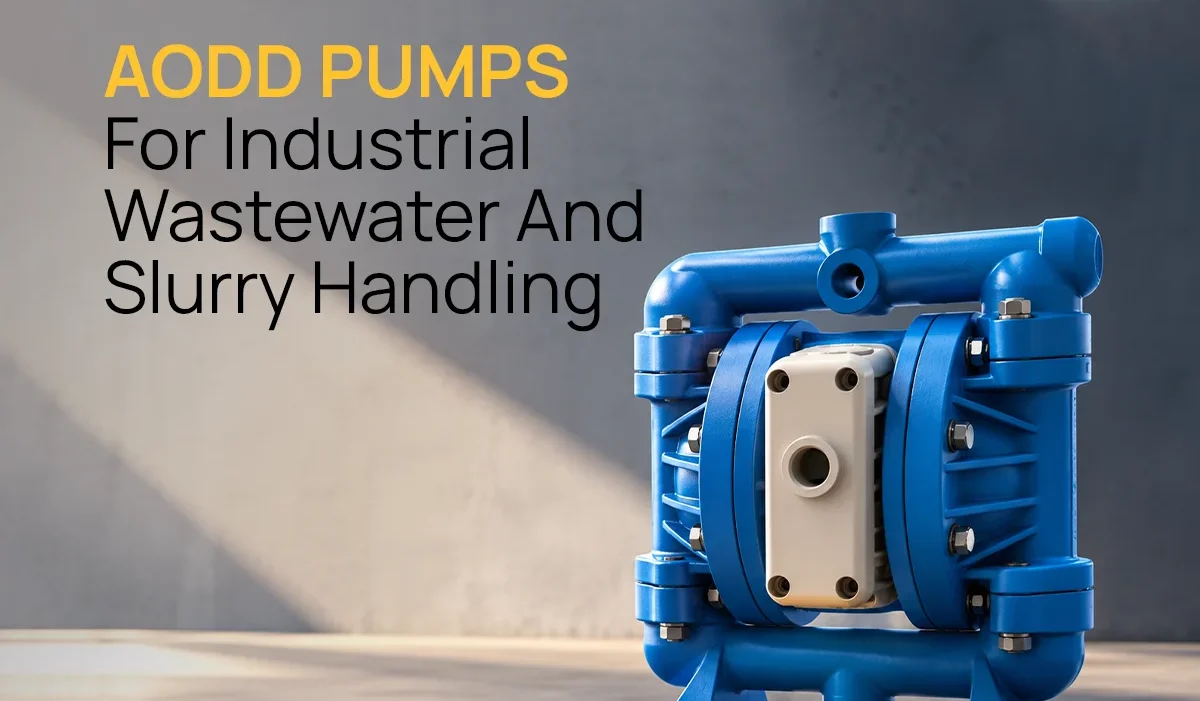
Industrial wastewater and slurry are among the toughest fluids a plant can ask a pump to move. They carry grit, fibres, sludge, chemicals and abrasive particles, and they rarely behave the same way two days in a row. At Teryair, we work with industries that face this challenge every shift, and one technology keeps proving its worth: the air-operated diaphragm pump. In this blog, we explain why an AODD pump is so well suited to wastewater and slurry duty, what to look for when selecting one, and how to keep it running reliably for years.
How Air-Operated Double-Diaphragm Pumps Work
Two flexible diaphragms are joined by a shaft and sit in separate chambers. Compressed air is directed behind one diaphragm, pushing it forward and forcing liquid out of its chamber, while the opposite diaphragm is pulled back, drawing fluid in through the inlet. An air valve then shifts the air to the other side, and the cycle repeats. Check valves keep the liquid moving in one direction.
There is no spinning impeller, no mechanical seal, and no electric motor in the fluid path. This is why the design handles dirty, thick, or abrasive liquids so calmly. Air-operated double-diaphragm pumps are also self-priming, so they can lift liquid from a sump, pit, or tank without manual priming.
Why Wastewater And Slurry Need A Different Kind Of Pump
Conventional centrifugal pumps depend on tight clearances and high-speed impellers. When slurry carrying abrasive particles passes through, those surfaces wear quickly, efficiency drops, and seals begin to leak. Wastewater adds its own complications: changing solids content, corrosive chemicals, fluctuating flow rates and, in many plants, hazardous areas where electrical equipment is a risk.
Diaphragm technology avoids many of these problems. The fluid touches only the chambers, diaphragms and check valves, and each of these can be specified in a material chosen for the duty. Because the pump is positive displacement, it delivers a steady volume with every stroke even when viscosity or solid content changes. Air pressure also acts evenly across the diaphragm, which balances mechanical stress and helps extend diaphragm life.
Key Advantages For Industrial Duty
Air-operated diaphragm pumps bring a set of practical benefits that matter on the plant floor:
- Handles solids and abrasives: Sludge, grit and suspended particles pass through the pump without clogging, and the gentle pumping action suits shear-sensitive fluids too.
- Safe dry running: The pump can run empty without damage, which is common when sumps are drawn down.
- Safe deadheading: A closed discharge valve will not harm the pump. It simply stops until the valve reopens.
- Self-priming: Good suction lift makes it easy to empty pits, trenches, and drums.
- No electricity required: Compressed-air operation makes these pumps a natural fit for explosion-risk zones and wet environments.
- Adjustable performance: Flow and pressure can be tuned by adjusting the air supply, with no complex controls.
- Seal-less design: With no mechanical seal to fail, leakage points and maintenance costs are reduced.
Where These Pumps Deliver The Most Value
Across industries, we see the same pump solving very different problems:
- Transferring effluent between treatment stages
- Draining sumps, pits and floor trenches
- Feeding filter presses with sludge
- Moving mineral, ceramic and mining slurries
- Handling paints, pigments, resins and adhesives
- Pumping chemical process wastewater
- Managing waste streams in textile, tannery and food processing units
The common thread is a fluid that is difficult, variable, or hazardous, which is exactly where this pump type earns its place.
How To Select The Right Pump
Choosing well at the start saves a great deal of downtime later. When specifying an AODD pump, begin with the fluid and work outward.
Wetted materials. Aluminium suits many general-purpose and cost-sensitive applications. Polypropylene and PVDF perform well with aggressive chemicals, while stainless steel is preferred for higher temperatures, hygiene needs, or demanding environments. Diaphragm and valve elastomers such as PTFE, EPDM, Buna-N and Santoprene should be matched to the chemistry and temperature of the liquid.
Size and flow. Port size should be chosen with the largest solid particle in mind. A pump that is too small will starve; one that is too large wastes air. Review the performance curve against your required flow rate and discharge head.
Air supply. Pump output depends on the air pressure and volume available. Make sure your compressor can deliver what the curve demands, or the pump will underperform.
Abrasion level. Highly abrasive slurries may call for harder valve balls and seats and a more frequent inspection schedule.
Hazardous areas. If the pump will operate in a potentially explosive atmosphere, confirm that it carries the appropriate ATEX certification and grounding provisions.
Getting Long Life: Installation And Maintenance
A well-sized pump still needs good habits around it. Here is what we recommend:
- Keep the air clean and dry. A filter and regulator on the air line protect the air valve from moisture and dirt, which are the most common causes of poor performance.
- Keep suction lines short and airtight. Air leaks at the inlet reduce priming ability and flow.
- Use flexible connectors and a pulsation dampener. Diaphragm pumps deliver a pulsing flow, and a dampener smooths this out while protecting pipework.
- Inspect diaphragms and check valves on schedule. These are the wear parts, and replacing them early prevents unplanned stoppages.
- Keep a spares kit on site. Diaphragms, balls, seats, and O-rings on the shelf mean a quick turnaround.
- Watch for icing at the exhaust. Expanding air can chill the muffler in humid conditions, so dry air helps here too.
Air-operated diaphragm pumps are among the simplest pumps to service, with few moving parts and no seals to realign. An AODD pump that is correctly sized, supplied with clean air, and inspected regularly can deliver dependable service in conditions that destroy other pump types.
Choosing The Right Partner
The pump is only part of the picture. The support behind it matters just as much. When comparing AODD pump manufacturers, look beyond the price tag. Ask about material options, certifications, factory testing, spare parts availability, and how quickly technical help is available when something goes wrong in the field.
The best AODD pump manufacturers help you match the pump to your process rather than simply selling a model. They should be able to discuss your fluid, your solids, your air supply, and your site conditions, and recommend a configuration that suits all four. For plants where a stopped pump means a stopped line, this guidance is worth as much as the equipment. Well-built air-operated diaphragm pumps backed by responsive service keep your operation moving, and your maintenance team focused on planned work.
Summary
Wastewater and slurry will always be difficult fluids, but the pump handling them does not have to be a constant source of problems. With the ability to pass solids, run dry, deadhead safely, and operate without electricity, an AODD pump offers a reliable, flexible answer for effluent treatment, mining, chemical processing, and many other industrial applications. Choose the right materials, size it correctly, supply it with clean air, and maintain it on schedule, and it will repay you with years of steady service.
At Teryair, we are here to help you select and run the right pump for your process. Get in touch with our team to discuss your wastewater or slurry application.
FAQs
It has no impeller in the fluid path, so abrasive solids cause far less wear and clogging, and it keeps delivering steady flow even when the fluid changes.
Yes, they can run dry and deadhead without damage.
It depends on the port and valve ball size. Choose based on the largest particle in your fluid and check the pump’s specifications.
Aluminium suits general duty, polypropylene or PVDF suits aggressive chemicals, and stainless steel suits higher temperatures or demanding environments. Match diaphragm materials to the fluid.
It depends on how abrasive the fluid is and how often the pump runs. For heavy slurry, inspect more often and keep a spares kit on site.